|
HOW CONGRESS WORKS
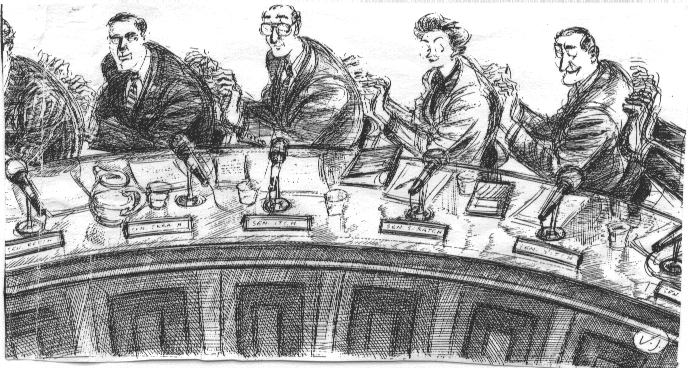
|
BASED UPON CONGRESS' SUPERVISION OF THE C-17 MILITARY
CARGO PLANE, AN EXPOSE REVEALING THE BUREAUCRATIC INEFFICACIES |
 |
|
CONGRESS FAILURE TO OVERSEE
A HOUSE DIVIDED
|
David Segal, The Washington Monthly/January/February 1994
There were newspaper accounts of cost overruns, murmurings of design defects,
and rumors of opposition within the Pentagon. In January of 1989, the militarys new cargo transport plane, McDonnell Douglas
C-17. had all the symptoms of a troubled{ program, and the Defense Subcommittee of the House Appropriations committee was
going to do something about it. Swinging into investigative mode, it assembled a handful of its members, summoned some military
brass, alerted the media and held . . . an informecial.
Sure, the event was billed as a Congressional hearing, but
that phrase evokes a semi-circle of unamused lawmakers bearing down on the glum, fifth-taking witnesses with lawyers at their
side. This event looked more like one of those scripted half-hour cable programs designed to sell rechargeable hand blenders.
All the elements were there: a genial host (Congressman Norm Dicks) helping an animated huckster (General Duane H. Cassidy)
sell us a product (the C-17) that we dont really need. And the sales pitch covered all the bases:
This thing really
does the job!:
Rep. Dicks: Isnt the C-17 much more capable of landing and taking off:
General Cassidy: It performance
is much better . . . It give us the flexibility inherent to being able to go more places.
Its loaded with great features!:
Rep. Dicks: The C-17 gives you that intratheatre capability.
General Cassidy: We have to be able to move and react
to fighting situation. The C-17 gives you that in the capability for the theater movement and you cant predict where that
is going to be.
The competition doesnt compare!:
Rep. Dicks: One of the major points that I think needs to be
pointed out is the number of fields in Europe that you can take the C- 17 to versus the [Air Forces cargo transport] C-5.
I mean it is very substantial.
General Cassidy: It is very significant, a factor of five to one.
The experts
love it!:
Rep. Dicks: Is there unity behind the C-17?
General Cassidy: This is the only program in DoD that has
full service support and all the
Commanders in Chief support it.
Youve seen it advertised elsewhere for a fortune
but were offering a low, low price!:
Rep. Dicks: There seems to be some confusion on the actual cost of the C-17. On January
24th in a Washington Post article headed Hard Time Ahead Over Hardware called the C-17 a (plane that costs an average of $483
million each when spare parts and hangar costs are included. General Cassidy: The unit fly-away cost of the airplane as we
consider it in then-year dollars is less than $125 million a copy.
Of course, had this been a real infomercial, the
FTC would have prosecuted Dicks and Cassidy for false advertising. The planes design was defective, the military had to reduce
its performance specifications three times, and its cost soars (each C-17 is now slated to cost $300 million). As all of these
facts made it into the press the months after this hearing, then Secretary of Defense Dick Cheney announced that the military
would buy 40 C-17s instead of the originally planned 210. He then fired one general an accepted the resignations of two others
in charge of the program. But at that point the military had already pumped billions into the program. As one former Office
of the Secretary of Defense analyst put it, There were always voices in the Pentagon arguing that the C- 17 was too expensive
and that there were cheaper alternatives, but nobody wanted to hear it.
A congressional hearing would seem an
opportune place to listen, but as the House Appropriations C-17 hearing suggests, lawmakers are often more interested in rah-rahing
programs and agencies than in thoroughly investigating them. Shameless pork politics? In part. If the C-17 gets built, after
all, thats jobs and federal dollars for someones district. If youre a legislator and those dollars are headed to your home
district, why ask tough questions? When members feel compelled to bring home the bacon, letting them do the watchdogging is
like asking Dead Heads to guard the medicine cabinetit puts duty at cross purposes with instinct. Lawmakers vie for federal
dollars, which can help them keep their own jobs, at the same time that they are supposed to find out when those dollars are
being wasted.
But more often Congress negligence comes from a far less craven impulsethe urge to get along. Theres
tremendous pressure for us to not criticize other, says Rep. Scott Klug, a second term member from Wisconsin. Theres pressure
not to kick somebody in the shin that you might have to work with tomorrow. The problem is that when it comes time to push
for legislation that is dear to them, legislators need all the friends they can muster. One quick way to lose friends is to
perform the sort of tough oversight that ends infusions of dollars to home states and districts. In other words, theres no
reason to dig hard even when the dollars are heading for your colleagues constituentscolleagues who later might take a dim
view of your favorite program, as well-intentioned and essential for the commonweal as it might be. Its tellingand alarmingthat
Rep. Dicks does not hail from southern California, where the C-17 is made. Hes from Washington state, home of Boeing, also
a major defense contractor, leading unsympathetic observers to allege that Dicks ardor for the plane was simply back-scratching
for his-two Golden State committee partners, gentlemen whom he might need to call on someday to return the favor.
So
Congress poor oversight track record isnt so much a scandal about greed and thievery as it is the inevitable result of asking
legislators to both make laws and see them implemented. But the Hills prevailing ethos of Ill ignore that if you sign on to
this has a price. It helps explain why Congress fails to stave off not just high profile catastrophes like the S&L collapse,
but quieter outrages as well: that one out of five dollars spent by the government goes for overhead; that one third of the
$200 million spent by Superfund went to paperwork; that there is person in government called the Federal inspector of the
Alaskan Natural Gas Pipeline earning $115,300 even though no such pipeline exists.
Congress is given plenty of resources
to ferret out these kinds of failures. The House and Senate have an elaborate network of 247 committees and subcommittees
run by a total of 3,400 staffers to divvy up the work. And these folk arent idle: In the past 16 years House committees alone
have held a total of 54,034 hearings or roughly 20 each day the chamber was in session. Theres also a kennel of accountants
and investigators in the General Accounting Office which can be sicked on any subject, not to mention Inspectors General in
the agencies themselves whose findings can be used to pursue queries.
But the Hill has been so ineffectual with these
tools that few people even realize that regularly appraising...programs is actually o of Congress duties. Most legislators
are simply wary of asking the tough questions that could make government work. To understand how this wariness affects even
courageous members, take a look at what pressures naturally spin out from the committee system a Hill culture.
Unnatural
Disasters:
To begin with, theres the workload. Consider Ted Kennedy, who is the chairman of four committees and a member
of six others. Enough keep him ricocheting around the chamber, right? But look at what just one of those jobs entails As chairman
of the Labor and Human Resource committee, Kennedy is the Senates point ii for the Department of Health and Human Services,
an agency with 127,000 employees, annual budget of $641 billion and 250 differ national health an programs. Keep an eye on
HHS would take six packs of Jolt Cola and late nights for even the most committed workaholic. Kennedy may be equal to task,
but its hard to believe he could be with slighting the roughly 220 hearings held last by the nine other committees on which
he sits. And the more jurisdictions you control, And the senior lawmaker from Massachusetts isnt unusual. Most senators have
the same amount on the plate; House members slightly less.
Then theres the baffling way that the committees divide
their work. Most agencies and subjects are scrutinized by a number of committees In some cases this simply leads to stasis.
Tort reform, for instance, is the domain of both the Judiciary committee and the Energy and Commerce committeethe former likes
the idea, the latter has opposed it and virtually nothing has been done on the subject because of the split of opinion. Other
times, overlapping jurisdictions lead to fights that ruin legislation. The House Ways and Means committee and the House Education
and Labor committee, for instance, both have a hand in student loans, and in the recent tug of war on Clintons proposed overhaul
of the system, a crucial component of itallowing the IRS to collect paymentsgot dropped.
The one thing a system like
this is unlikely to draft legislation and make wish lists of what produce is rigorous oversight. With lines of authority hopelessly
splintered and members too overextended to focus on one subject, accountability dwindles to the bare minimum. The standard
explanation for this muddled network is that it grew up gradually and has failed to change with the times. But twice in the
past two Appropriations, to name a fewwith the kind decades Congress has formedwhat else?a committee to rationalize the system,
and aside from very slightly reducing the number of members assignments, neither made lasting changes. The Hill is trying
it again this year with something called the Joint Committee on the Organization of Congress, but an advanced copy of the
groups recommendations shows that improving oversight is virtually its last priority. (Formed in the wake of the House Post
Office scandal, its focus is improving Congress ethical image.)
What gives? The simplest explanation is that the committee
system isnt about enhancing government, it is about congressmen broadening whats known on the Hill as that four letter word
t-u-r-f. The more committees you sit on, the larger number of jurisdictions you have control over, says Rutgers political
scientist Ross Baker, a former staffer on the House Rules committee. And the more jurisdictions you control, the more resources
you can extract on behalf of constituents and interest groups. Being able to extract more resources also means youre better
positioned to bargain and push for your own agenda.
Thats why the least popular committeesGovernment Operations in
the House and Government Affairs in the Senateare the two which exclusively perform oversight. Those investigations just might
turn up something that could make life unpleasant for past and future allies. There are oversight subcommittees in other committees
but their work has been extremely uneven. Today, only a few legislatorsmost notable John Dingell of the House Oversight and
Investigations subcommittee of Energy and Commercehave earned reputations as strong and thorough overseers. Its far easier,
and more comfortable, to make a name as a participant in deals rather than as a spoiler of them.
So the episodic melees
for the best slots invariable center on the big dollar outfits. Those tend to be the authorizing committees (which draft legislation
and make wish lists of what funding agencies and their programs should receive), and appropriations committees (which study
the budgets and write the checks). Last years crowd of freshmen fought for these choice spotsPublic Works and Transportation,
Energy and Commerce, Ways and Means, and Appropriations, to name a fewwith the kind of elbow-throwing that gets hockey players
suspended and fined. In one three way braw, Rep. Nita Lowey of New York even enlisted the help of a rabbi. Two years ago,
Republican Arthur Ravenel threatened to become a Democrat if party elders didnt give him his first choice.
For those
not on a high powered committee, next best is getting on as many low powered committees as possible. This is how the fracturing
of agency oversight happens. Smaller committees want as much federal acreage as they can get, so they look for reasons that
they should be lords of one part of a given agency.
The results of this are obvious in, for instance, the Federal
Emergency Management Agency (FEMA), the peoples who are supposed to provide relief after earthquakes, floods, and nuclear
accidents. No fewer than 15 committees and 23 subcommittees have a hand in the agency: Food and shelter falls to several committees,
fire prevention to several others, disaster response to several others, and so on. FEMA is a tiny agency, with an annual budget
of $983 million, so at first this looks like 100 congressmen in a rugby scrum over an Oreo. But once an earthquake or a flood
happens, FEMA hits the emergency appropriations lottery. After Hurricane Andrew swept through Florida, FEMA was suddenly working
with $11 billion and a spate of Congressional committees were prepositioned to direct where that money went.
For all
that Capitol Hill involvement, FEMAs post-Andrew performance simplyby now, famously complemented al disaster with a man-made
one. The clear solution was to make one committee responsible for the whole agency. Yet no restructuring occurred. FEMAs work
in the summers Midwest floods got higher marksthey managed to get checks to more people soonerbut the agency still serves
nearly two dozen different masters.
Beef Jerks:
While most members use committees to enhance the prospects of
their own bills and programs, others use their assignments to enhance their prospects for reelection. Most commonly, this
means vying for committees important in the state or the home district. Those, for instance, with local high-tech businesses
push for the Space, Science, and Technology committee. Those living near port areas try to get on Merchant Marine and Fisheries.
What often results is a group of like-minded lawmakers keeping tabs on agencies who, in turn, are keeping tabs on powerful
--and generous--industries with PAC dollars that might be crucial to members at election time.
Enough to make you
sick? Well, sometimes it does. The Department of Agriculture is supposed to inspect the meat industry, but its also meant
to promote the meat industry. The pro-consumer side of this contradictory mission isnt much enhanced by the House and Senate
Agriculture committees, whose members all hail from states like Texas(lots of cattle), or Arkansas (chicken), and Vermont
(milk) where agricultural business interests are major players. The chairman of the House subcommittee on Department Operations
and Nutrition is Charles Stenholm of Texas, who, according to a Public Citizen book, They Love to Fly . . . And it Shows,
was given no fewer than 37 plane tickets and $38,000 in honoraria in 1990 by agriculture business interests. His committee
colleagues fared nearly as well. The top 13 recipients of agribusiness plane tickets and honoraria178 of the former, $167,000
in the latter were on the House and Senate Agriculture committees.
Not surprisingly, these folks havent done much
about the six to eight million cases of food borne illness reported in the United States each year, some 9,000 of which result
in death, and 80 percent of which can be traced to bad meat or chicken. Hearings on this subject generally have a Shirley
Temple, look-on-the-bright side tone. This vapid cheerfulness got downright bizarre in the wake of the Jack-in-the-Box hamburger
deaths in early 1993. Congress reigning beef czar, E. (Kika) de la Garza of Texas ($22,000 in honoraria in 1990), breezed
into a hearing on the subject primarily to perform a rear guard action on behalf of the industry.
He stated his thesis:
I just have a couple short questions. One, I have been saying we have the safest food in the world of the major industrialized
countries of the world. Am I right or am I wrong?
Then he tried to pin the Jack-in-the-Box incident on Canada:
Now,
recently, one of my colleagues who chairs a subcommittee on another committee made a statement that beef had come through
Canada and that this may have caused what happened in Washington State.
Then he restated his thesis:
My
time is up, but I keep saying that we have the safest, we have the best food inspection system in the world.
Then
he left. Not surprisingly, theres been no improvement in the USDAs meat inspection system since then.
The price of
this kind of coziness is sometimes measured in dollars rather than deaths. The S&L bailout, for instance, would have cost
significantly less than $300 billion had friendly congressmen, especially those on financial regulatory committees, not exerted
pressure on regulators to keep so many ailing thrifts alive. The former committee chairman, Fernand St. Germain, got so chummy
with the S&Ls that his first job after losing his seat was lobbying for the thrifts on the Hill.
The ex-Representative
from Rhode Island was following a common career path. According to CongressDaily, 4O.percent of the members turned out by
the 1992 elections have started or joined consulting firms. . . signed on with Washington-based law firms, trade associations,
interest groups, and corporate lobbying offices. Which, naturally, provides just another reason to beg off oversight. Why
dig hard if you might one day want to work for these people?
Acts of Decency:
Members neednt be as rapacious as
St. Germain to lose interest in oversight. In fact, whats most insidious about the Hill is that it can change even those with
genuine good government fire in their bellies. How? Imagine youre the freshman representative from Michigan, and because you
are smart, decent and driven to do good, you draft a bill that will both balance the budget and end hunger in all 50 states.
You call it the Decency Act of 1993, and you set about lobbying for it. Meanwhile, youre determined to weed out all the waste,
fraud, and abuse you can find as the newest member of the Houses Rural Enterprise, Exports and the Environment subcommittee.
You pep talk a couple staffers and send them looking for scandals to unearth and millions of tax dollars to save.
Just
as the Decency Act is garnering signatures, those staffers come back to you with a couple of real scams, the kind that make
you seethe, the kind that you came to Washington to end. You listen to the details with fists clenched and teeth gnashing.
Then you feel a sharp pain in your stomach.
You notice that those incriminating letters and checks your staffers
photocopied were headed to some very familiar addresses, namely the home states, maybe even the home districts, of the very
folks youve been trying to sign on to your bill. Sure, youve got some solid proof of kickbacks and book-cooking, but going
public with it would mean ending programs important to some would-be co-signers. So you face a tough choice. You can either
forge ahead with your investigation and fight like hell to save taxpayers some money, or you can look the other way and win
acolytes for the Decency Act. By the way, you might not win the investigation fight, and itll surely make you a pariah in
any number of future deals. And anyway, your bill is a wonderful idea and come to think of it, itd look pretty damn good in
that next mailing and, well, you and the missus are beginning to like Washington and. . . .
You get the picture. I
know lots of situations where committee staffers have snooped around and found stuff and their boss showed no interest in
it, says Franidin Silbey, formerly an investigator with the Senates Labor and Human Resources committee. When you do it right,
theres the risk of stepping on someone elses bunions. Theres the risk of stepping on someone elses t-u-r-f.
Gregory
Rushford learned this the hard way. In 1977, Rushford became a staff investigator with the then second-term senator from Missouri,
Tom Eagleton. (Rushford, for the record, had been recommended for the job by the editor-in-chief of this magazine, an admirer
of Eagle-tons.) In a first person account for the Monthly, Rushford described his travails when he and his boss searched for
a subject to investigate. Just about every subject seemed to encroach on some member Eagleton couldnt afford to anger. Finally,
the two decided. to look into Food for Peace, an Agency for International Development-administered program that sold food
on easy terms to other countries.
Rushford knew that in 1976 a committee headed by Hubert Humphrey found that half
of the $50 million in rice, wheat and soybean oil sent by Food for Peace to Bangladesh had been lost to insects, rodents,
and mold due to inadequate storage facilities. Rushford quickly learned the cause: Twice as much rice was landing on the docks
as the Bangladeshis could safely store. Why? Because a couple of congressmen from rice-producing states had lobbied the White
House in 1976 to increase rice exports. One of those states was Arkansas, home to Senator John McClellan, the Chairman of
the Defense Appropriations subcommittee. McClellan had recently granted Eagleton membership on this powerful committee, and
so Rushford had early on been instructed not to come up with anything that might anger John McClellan. Further nosing around
Food for Peace only turned up other ways for Eagleton to annoy his colleagues. Within a few months, Eagleton fired Rushford,
explaining that he just wasnt comfortable with him. An administrative assistant explained to Rushford, I guess youre too much
the investigative type.
TV Winners:
The press, for its part, doesnt inspire the Eagletons of Congress by covering,
and thereby encouraging, rigorous oversight. What creates press interest are the sensational, scam du jour hearings. With
uncanny circularity, the ideas for these hearings usually come right from the newspapers which cover them, and generally they
are hurrumphing, headline-generating productions that have little to do with discovering why programs arent working. Also
popular is the seasonal hearing. Here the committees win clippings by addressing a topic timely enough to create its own news
peg. Take, for example, a recent joint committee hearing on violence in TV video gamesjust in time for holiday shopping.
The
most consistent attention-winning method is drafting new legislation, something most congressman far prefer to checking up
on laws that already exist. The House Energy and Commerce committee, for instance, has a hand in something close to 65 percent
of all legislationits purview spans billions in programs ranging from telecommunications to insurance to national energy strategy.
With so much at stake its worrisome to learn that the committee has only 25 staffers, not one of whom is nosing around programs
already up and running.
New legislation wins wider glory, and its also more fun. Getting to the truth about a given
program or agency takes energy, determination, and a willingness to wade through documents and detail. Agency heads dont arrive
on the Hill and confess their sins. In fact, they tend to wax operatic about a crack squad of bureaucrats delivering unsurpassed
efficiency and progress. Sometimes they simply lie, more often they just offer a novel take on the truth. Pentagon procurement
officials like to lard testimony with so much inscrutable arcana that legislators either keel from boredom or are flummoxed
into silence.
Bearing up under this onslaught and being willing to dig out counter-evidence requires not just time
and energy but a group of staffers who know where to look. Dingell and other serious overseers hire veteran investigators
with strong backgrounds in special subjects and the instincts of investigative reporters. But too many others are young and
new to the subjects theyre supposed to keep an eye on. One National Academy of Public Administration study concluded that
High staff turnover and lack of staff experience on Capitol Hill in many of the complex and technical areas exacerbate the
difficulties of oversight. In large part thats because congressional jobs are now widely viewed as a launching pad for careers
rather than a venue for public service. But members, especially the many committee chairmen, deserve the lions share of the
blame for hiring these people in the first place and then falling to push them to do oversight. Its up to chairmen to decide
how much time, effort, and resources are going to go into investigations and whether or not to take people on, says Rep. Dan
Glickman of Kansas. And few want to because oversight is complex and it isnt sexy.
Congress myopia, love of publicity
as well as its media-dependence are showcased in scandals like the Iran-contra. In June of 1985, the Miami Herald ran a story
entitled U.S. Found to Skirt Ban on Aid to Contras which described a meeting between Oliver North and a contra official. The
article caused nary a ripple on the Hill until The New York Times and The Washington Post picked it up. The House Intelligence
Committee headed Lee Hamilton, then lumbered into action by calling in North and simply asking him if the charges were true.
The ex-marine firmly denied everything and the issue was dropped. Sending a staffer to Central America might have clarified
matters, but Hamilton later said that his committee couldnt afford the trip. Rep. Michael Barnes, then chairman of the Western
Hemisphere Subcommittee of House Foreign Affairs made his own half-hearted investigative stab by writing Robert McFarlane,
head of the National Security Council, and demanding to review documents on Norths contra contacts. McFarlane knew legislators
only too well. He replied that Barnes could see the material but would have to read it himself. Barnes wanted to send an aide,
McFarlane stood firm, and again the issue was dropped.
Ultimately, Norths penchant for funnelling money to contras
was simply a case of the executive branch breaking a lawin this case, the Boland Amendmentwhich ,Congress had failed to enforce.
The Iran-contra hearings we eventually got were vintage Congress: a media-driven orgy of spleen-venting and speechifying which
happened well after anything could be done to prevent the crime.
Plane Speaking:
Oversight of the preemptive sort
is rare on the Hill, but its ingredients are hardly a mystery, and when it works right it can perform miracles. The paradigm
is Harry Trumans investigation of military contracting fraud during World War II. David McCulloughs 1992 Truman biography
recounts that as the military signed billions in contracts, rumors of profiteering reached the then senator from Missouri,
prompting Truman to do something unimaginable in todays Washington: He got in his car and drove. Logging some 10,000 miles
by himself, Truman visited a variety of army installations and defense plants, revealing his identity only when asked. In
one fort, he found as he put it, hundreds of men just standing around collecting their pay, doing nothing. Returning to the
Capitol, he hired some savvy investigators, organized a set of hearings, and examined crooked and deficient contractors one
at a time.
With the country beginning to mobilize, the political mood was not conducive to asking tough questions
about how the military was spending money. But Truman knew such questioning couldnt be more timely and he sent his tiny staff
directly to factories to learn first hand what was happening. A typical discovery was a rolling mill selling the Navy dangerously
inferior grade steel., the kind that cracks when you use it to build ships. The president of that company J. Lester Perry,
had little luck hair-splitting his way through a question and answer session with two members of the committee:
Perry:
I still insist that it [the steel] was not inferior for the end use to which it was put...
Sen. Ferguson: In other
words, you are the man who is stating what you think the government should buy?
Perry: No, sir.
Sen. Ferguson:
Then why dont you live up to the government specifications?
Perry: We should.
Sen. Ferguson: Why didnt you?
Perry: We will.
Sen. Truman: Ill say you will.
A different tone from the Dicks/Cassidy love-in. By
1943, estimates were that the committee had saved the country $15 billion, a rough guess since Trumans real effect was deterring
fraud before it could do damage. As McCullough points out, fear of investigation caused innumerable contractors to clean up
their act before their act got examined.
There are modern and smaller-scaled analogues to this triumph. Ironically,
one of them is the C-17. As the rest of Congress pumped money into the program, two investigators at House Government Operations,
a committee which is chaired by Rep. John Conyers, began to study it.
Both Joe Serincioni and Erik Thorsen were well
versed in defense issuesthe latter had spent four years in the Pentagon. They knew where to look, what questions to ask, and
which documents to demand. When the Pentagon refused to hand over something, Conyers subpoenaed it. When the House Armed Services
committee squawked, Conyers ignored it. A parade of witnesses were called to the carpet and third-degreed. Heres Conyers with
Colonel Kenneth Tollefson, the Air Forces defense plant representative at McDonnell Douglas, as Tollefson tries to put a happy
spin on a 98 page document the company had given the Air Force in 1990. The document listed the C-17s problems:
Rep.
Conyers: Wait a moment. But 98 pages of what?
Tollefson: Of waivers, deviations or work that would be carried forward
at Edwards and completed there.
Rep Conyers: Some pretty serious?
Tollefson: Serious, I guessI am prepared...
Rep Conyers: We have the documents. Some pretty serious.
Through it all, military officials concealed facts
and constantly lied about meetings and money. The dust is still settling on this affair, but the press reports that sparked
Cheney to reduce the total C-17 buy and get rid of three generals were the direct result of Thorsen and Serincionis work.
The Truman and Conyers successes share two critical similarities. First, both men, thanks to the press, made a name
for themselves through their oversight work. Trumans hearings, in fact, landed him on the cover of Time, made him a national
political figure, and helped him become Roosevelts vice president. But this kind of notoriety is altogether too rare, especially
for members conscientious enough to do legislative oversight. The press isnt interested in the yeomans work of ensuring that
programs are functioning as promised, and so the yeomen that do it dont win the fame that their colleagues drafting new legislation
or holding splashy hearings can often count on.
In 1979, for instance, the Senate Committee on Commerce, Science and
Transportation noticed that the Federal Aviation Administration was foot-dragging on its promise to install a new mid-air
collision traffic alert system. Chairman Howard Cannon lit a fire under the FAA by setting a precise timetable for implementing
the system. The agency became, as a National Academy of Public Administration report put it vitally concerned with the project,
and significantly accelerated implementation of the system. Ideally that sort of quiet congressional intervention would win
lawmakers the lasting adoration of America, but Cannon was known only in Washington and his home state of Nevada, and in those
places only as a conservative Democrat with a nerdy streak. We need more Howard Cannons, but its unlikely well get many until
the press ballyhoos his methods. One of the Hills favorite committee reform proposalsrequiring each committee to publish an
oversight agendamight work like a charm if the media made a point of holding chairmen to it, noting those who failed, and
praising those who succeeded.
Secondly, both Truman and Conyers were on committees dedicated exclusively to oversight.
Their reputations were staked on whether money was saved and programs were working. Removing the standard, built-in conflict
of interest that bedevils other committees might result in the same kind of successes. For as long as a single committee is
supposed to both write checks and perform oversight, oversight will get slighted. Real reform would require that Congressmen
focus on one or two subjects. Then it would strip oversight functions from appropriating and authorizing committees (most
of their time is taken up with writing budgets anyway) and establish more committees dedicated solely to oversight. This wouldnt
require more c3mmit-tees if you followed Senator Nancy Kassebaums excellent suggestion of merging appropriations and authorizing
committees and using the left over resources to set up more oversight.
These steps will mitigate the problem, not
eliminate it. Congressional oversight is one of those messy, tight corners of democracy because it necessarily gives lawmakers
two radically different, virtually contradictory roles. The right restructuring and a press that covers what counts would,
however, increase our odds of resolving that conflict in a way that benefits everyone, not just narrow special interests and
certain home districts. It will go a long way toward producing more Trumans and fewer infomercials.
David Segal, The
Washington Monthly/January/February 1994
|