|
Parliament of Whores |

|
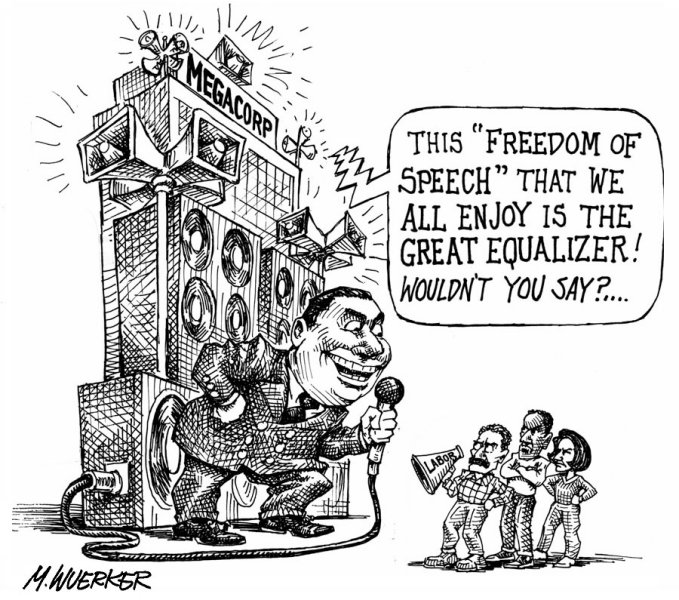
Right-wing Propaganda Machine--Brock & JK
The Republican Noise Machine David Brock This book illuminates why Republicans now unabashedly serve the wealthy elite—and the Democrats have also drifted
further to the right: the production of ideas has shifted to the right. The media has a strong conservative bias. A book worth knowing.
A former right-wing journalist, David Brock, uses his keen understanding and experiences to show how a conservative
media has skewed American politics: they have hijacked public discourse. Brock’s incisive analysis of right-wing media theories, strategies, financing,
and operations demonstrates how the Republican Right does not embrace or encourage journalistic freedom, but instead seeks
to control it. With billions of dollars to spend and a readiness to demonize
dissenting voices—combined with media consolidation and deregulation of the airwaves—the conservative, media machine
has reshaped national consciousness. Brock documents the shift, which started
in the Nixon era, from balanced journalism to opinion journalism. Brock documents
the causes as to why the conservative news bites are several-fold more common than the liberal ones, thus assuring in the
production of ideas a dominance of the conservatives. Money, ownership of the
media, and changes in FCC regulations are the principle causes—no longer does the FCC require balanced and objective
news reporting.
In The Republican Noise Machine Brock details the assault on balanced journalism
by the conservatives. There are chapters on what he terms as the “Big Lie”
that the media has a liberal bias. A chapter on the Republican attempts to and
finally success in changing removing the Fairness Doctrine. He developed in chapters
conservative media content, the rise and effects of talk radio, fundamentalist Christians taking to the air, and related topics. This shift in the capitalist media has made this nation the most conservative of all
industrialized ones. What is beyond the full scope
of Brock’s book is why this change has occurred—each class is at war with the other classes. The conservative capitalists have always had control of the media and always sought to promote public opinion
that would be to their class’s economic advantages. Things have changed
from 60 years ago. Total exposure to the media has increased through the car
radio, and then television. The media bombards the public with conservative ideas
including a worship of wealth and the wealthy, a glorification of the profit motive, and a portrayal of the lower depths as
fundamentally sick and undeserving. Liberal and pro-labor ideas are rare. Changes in legislation which do not serve the masses, such as laws affecting unions
and NAFTA are not given balanced coverage. With the reduction of organized labor
from a high of 35% to under 8%, the voice of labor has been lost. The market
for programming has changed. The other major cause of the
shift is that owner of radio stations are, as the business class general is, far to the right of main-stream Americans. The Fairness Doctrine, passed by Congress in 1949, was ruled in 1986 by a conservative
3-panel Court of Appeals as not being a binding requirement—in spite of clearly language otherwise. Congressed the following
year, 1987, reaffirmed their intent, but Reagan vetoed the bipartisan fix. Balanced
content now is no longer a requirement for renewal of their FCC Broadcast License. In
1989 the conservative packed Supreme Court ruled that against the people’s right for balanced reporting and in favor
of the owners of the media’s right through ownership to control content. The
airwaves are no longer a public trust. In the 70’s the
conservative, fundamentalist religions expanded presence in the media. By the
80s they ran 3 syndicated sources of programming, and every market had stations that exclusively religious radio and television
stations. All three networks have an anti-liberal, pro-conservative bias. Fundamentalist Christianity is being promoted, and thus there has been a shift in
Christianity away from the liberal churches. This has further reduced the number
of liberal voters. Political actions of the two
parties is like an ecosystem in that it responds to (shaped by) its environment. The
two parties feed on money and votes. Reduce the amount of money and votes coming
from unions and other liberal sources and you have a swing towards the conservative.
The reduction of unions, the drift towards fundamentalism of Christianity, and the constant conservative bias of the
press has produced such a shift, and with that shift, everything else has shifted--including the Democratic Party. The forces of pro-big business
conservatism were well organized by the beginning of the 20th century, and they have slowly made inroads upon the
beliefs of the working class. These inroads, however, were temporarily set back
with the great depression. Following the 2nd World War, the erosion
of class consciousness resumed under the continuing control by conservatives of the media.
The reduction in unions and the growth of religious fundamentalism supported the drift in the press and politics to
permit more actively support big business. Barry Goldwater ran 20 years ahead
of his time. Since then we have had 4 elected Republican presidents whose social
and business policies are in the Goldwater camp. Just as the Republican Party
has drifted to the right in response to a changing voter’s consciousness, so to have the Democrat Party, who now resemble
the liberal Republicans of Eisenhower’s era. The media has led this drift
to the right. Brock’s book documents in minutia this change in the media. This imbalance in the production of voters’ beliefs
entails an ever increasing shift in public policy in the direction of policies which corporations view as in their short-term
interests; viz., those that increase profits. A large pool of poor, needy people
to drive down the cost of labor is one of their goals. Thus a reduction in quality
of public education, social services programs including benefits for the sick and elderly, workers benefits, union rights,
medical benefits, pension plan contribution are among the principle changes. This pattern
of change is not isolated to the [i][i] A Public Betrayed:
An Inside Look at Japanese Media Atrocities and Their Warnings to the West, Adam Gamble & Takesato Watanabe, Regnery
Publishing, Inc. [ii][ii] Id xiv. |
|
THE REPUBLICAN NOISE MACHINE: Right-Wing Media and How it
Corrupts Democracy David Brock Crown Publishers, A fundamental change in law (repeal of Fairness Doctrine) under the Reagan Administration
has permitted the conservatives, who through ownership dominate the media, to use it to set the table of general opinion far
further to the right. This section from Brock’s book goes into the history
of how that was accomplished; and why now, after they have packed the courts, this shift is here to stay--jk. Picking up where Nixon left
off, Ronald Reagan took office determined to further deregulate the communications industry. The Reaganites viewed the broadcast
media not as a public trust that was obligated to operate in the public interest by providing a free flow of ideas from a
variety of sources, but as any other commercial business—a position at odds with fifty years of federal policy, court
decisions, and journalistic traditions. The Reagan era saw a number of media companies absorbed into larger conglomerates,
increasing pressures for profits and relaxed standards. As broadcast properties were swallowed up, by the late 1980s there was a discernible impact on content, favoring,
for example, the kind of profitable right-wing trash talk offered by Morton Downey. "Deregulation has brought in a new breed
of broadcaster to whom public service matters less. They're willing to close their eyes and say 'Go ahead and put it on.'
This creates pressure for broadcasters who know better and say privately they hate this land of programming but have
to do it to compete," Andrew Jay Schwartzman of the Media Access Project told the Washington Post in 1988. The Federal Communications Commission is a government agency established in 1934 to regulate the public airwaves
to maximize "the public interest and to encourage a diversity of voices so as to promote a vibrant democracy." To chair the
agency, Reagan appointed Mark S. Fowler, a communications lawyer who had served on the Reagan campaign staffs in 1976
and 1980. "The perception of broadcasters as community trustees should be replaced by a view of broadcasters as marketplace
participants," Fowler said. Fowler famously compared the TV broadcast media to a "toaster with pictures." And he declared
his contempt for public affairs journalism as " Earlier, Fowler had been an announcer, disc jockey, and station manager in Fathers Coughlins right-wing tirades appear to have provided some impetus for the fairness rules.4
The Kennedy administration used the Fairness Doctrine to challenge the imbalanced presentations of right-wing radio broadcasters.
And throughout the 1970s and 1980s, the Fairness Doctrine was invoked by, among others, parties seeking time to respond to
biased broadcasters of the religious Right. In 1969, the Supreme Court
unanimously upheld the constitutionality of the Fairness Doctrine, ruling for an author, Frederick J. Cook, who had been attacked
on a Christian Crusade broadcast aired on a radio station in But the
people as a whole retain their interest in free speech by radio and their collective right to have the medium function consistently
with the ends and purposes of the First Amendment. It is the right of the viewers and listeners, not the right of broadcasters,
which is paramount.5 Mark Fowler disagreed. On the air, he had been known as "Madman Mark." At the FCC, he would be called "the Mad
Monk of de-regulation."6 Assuming the reins of the commission, he set about "pruning, chopping, slashing, eliminating,
burying and deep-sixing" fifty years of regulations that guarded against monopolistic practices and excessive commercialism
and protected the public interest standard. Rupert Murdoch, who would win favorable regulatory rulings from the Reagan FCC
allowing him to expand his media empire, called Fowler "one of the great pioneers of the communications revolution" and
"perhaps the most successful of any Reagan appointee."7 (A decade later, under new leadership, the FCC concluded
that Murdoch had misled the Reagan-controlled agency when giving assurances that News Corp. was not foreign-owned and
-controlled.) Among other changes, Fowler
aimed to gut the Fairness Doctrine, opening the public airwaves to "rigidly partisan" views, with no safeguards for balance.
To act as general counsel of the FCC, Fowler appointed the right-wing lawyer Bruce E. Fein, a creature of the right-wing network's
subsidized legal arm. Fein held research posts at the Heritage Foundation and the American Enterprise Institute and was
"Supreme Court editor" of a publication called Benchmark, published by the Center for Judicial Studies, which was directed
by a former aide to Senator Jesse Helms. As a midlevel official of the Reagan Justice Department, he had been tasked with
judicial selection. Though in the Fairness Doctrine debate he would pose as one, Fein was not a friend of the First Amendment
or of independent journalism. He argued that the landmark Supreme Court case New York Times v Sullivan was "wrong,"
and he called for congressional investigations into "media inaccuracy, bias, and misreporting." As the architect of the Reagan assault on the Fairness Doctrine, Fein argued that the advent of cable, and the
explosion in the number of radio stations licensed by the government to broadcast since the late 1940s, rendered moot
the fear that a handful of broadcasters could dominate the airwaves with a few points of view or censor opinions they
didn't favor. In fact, he said, the Fairness Doctrine was inhibiting a diversity of views in the media and thus might be unconstitutional.
Fein claimed that the federal regulation had made the airing of "controversial programming" prohibitively expensive for
broadcasters, because they had to spend money airing the other side of controversies. The result was an "undisputatious and
unedifying" media landscape, as Fein described it. For Fowler and Fein, revoking the Fairness Doctrine was another way of "expanding the spectrum" rightward, along
the lines originally suggested by Edith Efron, who had argued that openly biased right-wing broadcasters should be allowed
to compete with the slanted "liberal" TV networks without Fairness Doctrine constraints requiring them to air competing perspectives.
Yet Efron s analysis of the networks was wrong. There were no partisan liberal broadcasters to compete with partisan right-wing
broadcasters. Despite what he said, Rush Limbaugh was not "equal time" for Dan Rather; they were not in the same business.
Only Limbaugh would benefit from the license to be unfair. The right wing was split on the question of repealing the Fairness Doctrine; among others, Reed Irvine and Phyllis
Schlafly, who had used the regulation as a way to insert their ideology into the media over the years, supported its retention.
But the big guns on the Right backed repeal. NCPAC’S Terry Dolan, who had
launched and funded an attack on the "liberal media," was a key supporter, as was the Heritage Foundation. Richard Mellon
Scaife s Landmark Legal Foundation challenged the constitutionality of the doctrine in the courts. A new front group was established
specifically to attack the Fairness Doctrine. The misnamed Freedom of Expression Foundation, which received money from the
communications, tobacco, and beer industries, and from the Olin Foundation and Rupert Murdoch, was headed by Craig Smith,
a former official of the National Republican Senatorial Committee who would serve on the Bush transition team in 1988. The
foundation s purpose, Smith said, was to "coordinate the repeal effort using non-public funds . . . which could provide
lobbyists, editorialists, and other opinion leaders with needed arguments and evidence."8 In 1986, the Court of Appeals for the District of Columbia Circuit, which had been packed by Reagan with right-wing
ideologues, upheld a loose interpretation by the Reagan FCC of an aspect of the Fairness Doctrine ruling that
Congress had never made the doctrine a binding requirement, despite statutory language suggesting that it had.9
The vote was 2-1, with Judges Antonin Scalia and Robert Bork in the majority. In 1987, the Reagan FCC, under the chairmanship
of Dennis Patrick (a young Reagan aide who took office upon Mark Fowlers departure), used that decision, and
a subsequent one from the same court, as an invitation to repeal the doctrine entirely. The move also was supported by some professional journalists' associations and many political liberals who
viewed the Fairness Doctrine as an infringement of the First Amendment rights of broadcasters. They failed to see that the
right wing was invoking the First Amendment while seeking to undo it. "Madman Mark" killed the Fairness Doctrine. Congress promptly restored the doctrine by a wide bipartisan margin,
but the legislation was vetoed by President Reagan. Subsequent efforts to revive it were thwarted by veto threats from the
first President Bush; again it was kept down during the Dominance of the radio airwaves
by the political Right would not have been permissible under the Fairness Doctrine. With that protection removed in 1987—in
an action engineered by right-wing activists, politicians, and judges—radio stations were free to program as many
hours of one-sided right-wing talk as they wished and to eliminate competing views at will. The newly powerful right-wing
hosts were able to say anything—to misrepresent, distort, and lie without challenge or rebuttal. In 1988, former ABC executive Ed McLaughlin took Rush Limbaughs show national. Unlike the subsidized right-wing
media such as the Washington Times and The American Spectator that provided a good deal of his content, Limbaugh
had emerged on his own, catching a wave of resentment against the gains of women, ethnic minorities, and gays. He was filling
a void not only in an untapped market but also in the conservative movement, following the Reagan presidency. In some ways,
he literally filled in for Reagan, who had been on the radio every day for five years in the 1970s reaching millions of listeners
per week. "Now that I've retired from politics, I don't mind that you've become the number one voice for conservatism in the
country," Reagan wrote Limbaugh. The difference between Reagan
in the mid-1970s and Limbaugh in the late 1980s was that Reagan was one voice among many competing ones, just as Joe Pyne
had been in the 1960s. Pyne usually had a liberal on the air with him; with their one-sided messaging, Limbaugh and his progeny
would corner the market in radio, which now had government permission to become a purely commercial enterprise like the
entertainment or pornography industries. Among other things, the end of the Fairness Doctrine meant that stations could reflect the political perspectives
of their owners. Alongside efforts to eliminate the fairness requirements, the Republicans were working to make
it easier for a handful of corporate owners to dictate content. Beginning in the Reagan administration and continuing
through the administration of George W. Bush, waves of Republican-backed deregulation undid government protections against
ownership consolidation and concentration. As fewer owners chased the same audiences, the right wing tightened its grip on
the broadcast media, and other views were shut out. The political effects of deregulation
were felt most keenly in radio. For fifty years, government limits on radio ownership were designed to encourage local
and diverse programming. Regulation made radio a very competitive industry and kept many small owners viable. Under long-standing
rules, a company could own no more than twenty-four stations nationwide and only two in the same local market. In
1996, these ownership caps were lifted by the Gingrich-controlled Congress, creating in effect a government-sanctioned
oligopoly that all but ended competition and diversity of views on the radio airwaves, that sabotaged First Amendment principles,
and that threatened democracy. Today, three companies own half of the radio stations in the Radio is ruled by niche markets, and Limbaugh was the first to develop a profitable niche just as talk was emerging
as the fastest-growing format in the country—the savior of AM radio. In 1981, there were 82 all-talk stations.
By 1995, there were 1,308. By and large, radio station programmers were opportunistic followers, not innovators. Programmers
were loath to challenge what was buoying the ratings. Station profits are built on loyal audiences with particular tastes—be
it country music or conservative talk— that advertisers want to reach. Just as country music fans do not want jazz interrupting
the programming on their station, right-wing listeners expect wall-to-wall right-wing opinion whenever they tune in, and they
balk when they don't get it. The right wing and its financial backers had gotten to market first and locked up the entire day's programming
on desirable high-powered stations around the country. Because radio's electromagnetic spectrum is finite, there was less
room to establish powerful liberal talk stations or networks even if there had been the financing to do so. While conservatives
like Sean Hannity could be "discovered" by doing practice runs while substituting for Limbaugh, liberals had no viable launching
pads. The few brand-name liberals who were given an opportunity in radio (such as former Radio is also a populist medium. Right-wingers of the Limbaugh variety become faux populists with their cultural
appeals, while remaining supportive of the agenda of economic elites. Former
If there lips are moving they are lying. The one thing you can be sure that they stand for, is to get elected. To understand developments in our political system
(both parties) one must understand the role of neoliberalism. Any analysis which
misses this connection is grossly inadequate. (Neocons follow neoliberalism economic
policies). We have an evil, evil system. Words such as imperialism, greed, corporate greed, neoliberalism, neoconservate, globalism, bought politicians,
control of media are descriptive. There are reasons why the labor movement
has collapsed. It is the politics of neoliberalism, an out growth of corporate
greed. Given how it opposes the public weal, we have devoted a section to expose
just what neoliberalism is—a thing that the five corporations which own broadcasting will not do. THE BRINK OF ECONOMIC COLLAPSE Things have gotten worse, the hole the neocons has dug
is much deeper. The economic stats are worse than bad: the trend is toward greater disparity of wealth and on top of that the |